


You can tell it’s November because fireworks have been going off since Halloween, and the shops are full of Christmas stuff. Yes, the C-word has been mentioned. For the record, the scribes are all in favour of it (Xmas, Yule, call it what you will), but at the proper time of year. They would like to point out to retailers that there are 12 Days of Christmas, none of which are in November.
So, back to the current month and what has been happening since the last Newsletter.
Works In Progress
This section should more realistically be called Works In Limbo since not much writing has been done in the past month. To begin with, there was a Medical Thing to attend to. Without going into the gory details, there was a hospital visit followed by a fortnight of no strenuous activity and no heavy lifting. Now, I know what you’re thinking. Writing does not ordinarily involve lifting anything heavier than a pen (okay, a pad of paper weighs more, but let’s not be pedantic about this) and scribbling a few lines down can hardly be classed as energetic exercise. This is empirically true but does not take account of the update to No Man’s Sky that happened. Updates to the game usually mean there is a new expedition to go on. That took care of the first week.
While a certain space-suited pioneer was being haunted by jellyfish ghosts (the expedition came out around Halloween and was called “Cursed”), I got a call from a family member asking about the family tree. I’d researched and put together a reasonably comprehensive one that I’d last updated in 2012. The program that it was on (MacFamilyTree) did not run on the current computer. Well, it sort of did, but everything was mangled and came out looking wonky. As it happened, there was a new version of the program, and it was on sale. I bought the update and de-wonked the tree to make it straight again. That led me to wonder if any of the dead ends that I’d hit in the past might have new leads. An offer on a three-month subscription to Ancestry and I had the answer. There were.
Now, having in a former life been an archivist in a county record office (well, more than one), I will spare you the details (see, that’s twice now I’ve spared you the details about something). The old thinking was that family history was deadly boring to anyone but the family in question. That was before they started making television programmes about famous people’s family history, where they find out that great-granddad was on the U-boat that sank the Lusitania and was descended from royalty and later died in the workhouse from tuberculosis caught on a cotton plantation. Or something like that. Long story short, things got interesting. Connections were made, dots joined up. As so much more is available online than it was ten years ago, the tree had a growth spurt and put on a few new branches. I now have a whole load of new dead ends to think about. That took up a good fortnight.
Which brings us up to the past week. Writing has re-commenced, or to be more precise, re-writing has re-commenced. Pass The Duchy is about two-thirds done in the machete edit. It felt like coming home to an old friend. The word count is still higher than it was at the beginning but has stopped growing. Time will tell if I need to go through it again to chop stuff out. The Scriptorium Chronicle is out with a beta reader so I’m not thinking about that. Everything else is on hold. I need to finish what I’m working on first before going back to them.
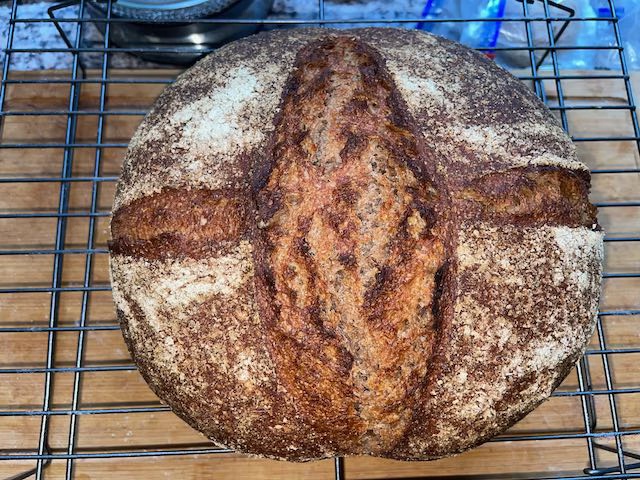
The scribes have continued in their attempt to make sourdough maslin bread and are quite pleased with the latest result. They used a different technique to prove the dough and think they’re starting to get the hang of it now. For those not in the know, maslin is a mixture of different sorts of grains, typically wheat and rye, grown together. It was a crop widely grown by feudal peasants in England where the climate and soil weren’t favourable for wheat alone, which was pretty much anywhere but the South. Until the advent of industrialisation in the late 19th century and the Chorleywood process in the 1960s, it was the bread that most people ate. As bread tins didn’t appear until the 1700s the loaves would have been round and domed shaped with a flat bottom and baked on a bakestone or the flat floor of a bread oven.

The Wildflower Meadow (formerly the Front Lawn)
Picture, if you will, a sward of green with bees and butterflies flitting from flower to flower that sway gently in the breeze of a summer’s day. Now imagine that sward cut down to ground level and raked clear and the bees and butterflies hunkering down for winter. This is where we’re at with the wildflower meadow. The last of the evening primrose has finally succumbed, but the odd red clover is somehow managing to hang on. Spring bulbs have been planted to give the pollinators an early helping hand. Other than that, there’s not much to be said.
The kitchen garden has been mostly cleared. The leeks are doing well, as is the chard. Garlic, spring onions and regular onions have been planted. The next job is raking up leaves. There are a lot of leaves. The compost bin to make leaf mould is already overflowing. Borders and hedges are being eyed up as potential places of deposit.

Dear Alexa,
Through nobody’s fault, certainly not mine, a page of handwritten instructions relating to something I can’t say what it’s for has gone astray. The place has been turned upside down in the hunt for it, but despite our best efforts, it remains unfound. I know it will be in the last place we look (because that’s the point we’ll stop looking because we’ve found it), but it has been several months now. We’ve run out of excuses about why this set of instructions hasn’t been included in a monthly periodical that can’t be named, and the person who wrote them down is mad at us and refuses to contribute to the Newsletter until it is found and matters are put right.
Edgy Ed
Dear Edgy Ed,
Well, this is a tricky one. If these instructions haven’t been found by now, I doubt they ever will be. A little bird tells me that sometimes, just sometimes, duplicate instructions can be found elsewhere, say on page 312 of a cookery book that lives on the top shelf in the kitchen. A helpful person might have already bookmarked it for you. For the person you’ve managed to annoy because you’ve been stringing her along for months now, I think you’ll find that a big bunch of flowers and a box of chocolates will help. Mrs Pritchett likes Thornton’s Continental.
Alexa

The recipe for Lemon Drizzle Cake is still missing, and Mrs Pritchett has taken the hump and refuses to give it again in protest at what she calls a disregard for the feelings of others by a bunch of slackers. At least, that’s what the scribes think she said. They have had a long think about what they could come up with to fill in the Recipe Corner themselves and thought that a masterclass on how to cook perfect rice might be just the ticket.
Rice
A rice cooker is probably the easiest and most convenient way to cook rice. However, not everyone, scribes included, has one of these or indeed needs one if this simple-to-follow method is used. All you need is a heavy-bottomed saucepan with a tight-fitting lid. And rice.
Serves 4
Prep time: 5 mins
Cook time: 30 minutes
Ready: 35 minutes
Ingredients
200g long grain rice
300ml water
½ tsp salt
Directions
1. The first step is to wash and rinse the rice. I know you’re going to be boiling it and think you can skip this step but this is probably the one thing that makes all the difference between rice that is stuck together and rice that isn’t. Rinse it in a pan or bowl, tip into a sieve and run the sieve under cold water for 10-15 seconds until it runs clear. Let it drain completely for about 30 seconds.
2. Place the drained rice, measured-out water and salt in a pan. Gently swirl the pan so that the rice is spread evenly and covered. Bring to a simmer, uncovered, over a medium-high heat and when it starts to simmer, cover with a tight-fitting lid and reduce the heat to low. Cook for 18 minutes and then remove from the heat. Keep the lid on to keep the steam in and let it stand for a further 10 minutes. Do not remove the lid, not even to peek at how it is doing until the 10 minutes is up. Got that? No peeking. Seriously.
3. Uncover and fluff with a fork. Transfer to a bowl and serve.
Scribes’ Note:
Getting rice that isn’t too watery, mushy, hard or burnt isn’t difficult but you do need to know the basics (rinse well and cook with a lid on low and slow) and tweak the amount of water for different types of rice.
Treat jasmine rice like long grain rice (300ml of water) and cook for 15 minutes, stand for 10.
Basmati rice needs a lot more rinsing until the water runs clear and needs to stand in water for half an hour before cooking. Drain and cook in 315ml water for 12 minutes. Remove from heat and let stand for 5 minutes.
Short grain rice. Rinse and drain like long grain. Cover with 235ml water and let stand for half an hour before cooking. Cook for 13 minutes and let stand for 10.
 Mark Weaver