
Well, we’re in June and the Scriptorium Newsletter has hit its first anniversary. One year ago, almost to the day, the first edition went out into the big, wide world. Many, the prior included, doubted that it would make it past issue three. When the fourth issue came out, there was no way it would still be going in six months, and yet here we are.

Mrs Pritchett has donated a bottle of her sister Dolly’s home-made elderflower champagne to help celebrate the event, and she’s made some ginger nut biscuits and decorated them with icing.

Rather than doing a retrospective (previous editions of the Newsletter are available on the scribes’ website), the scribes are looking forward to what the next twelve months will bring. So much has been accomplished, and yet there is still so much left to do, and that’s not taking into account the regular work needed to maintain the priory and all the other little jobs that need doing. So, once the cork has been popped, the contents of the bottle quaffed and the biscuits scoffed, it’s back to work. There are books to finish and new ones to start.
Works In Progress
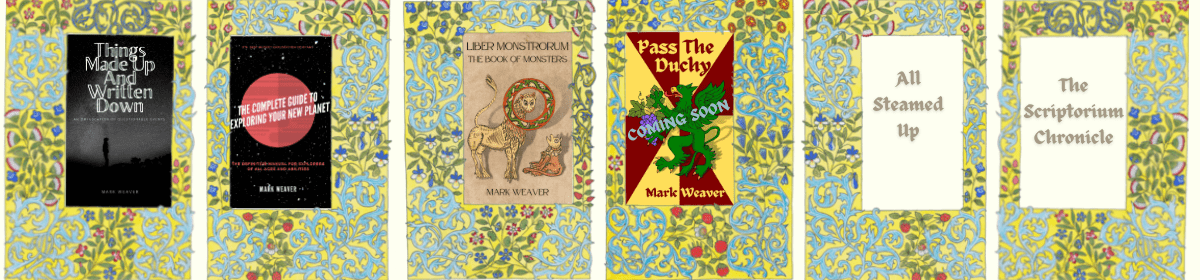
The main news is that Pass The Duchy is close to completion. The last chapter (not the final chapter, but the one before) is being rewritten to bring the book to an improved ending. Having gone through the machete edit to chop out all the extraneous guff to make it read better, I felt that the ending seemed rushed. The rewrite of what has been less than half a dozen chapters has seemingly taken forever. I think part of the problem has been that rather than throw a lot of words down and then edit them afterwards, I’ve been trying to carefully splice them in so that you can’t see the join. I don’t know which way would have been best, but the way I’ve been doing it is working—it’s just painfully slow.
The downside to the rewrite is that the machete edit has not had the intended effect. The wordcount has gone from 89k at the beginning to 103k, which is the complete opposite of what was supposed to happen. My guess is that it will finish around 104-105k words. Then will come the tricky part. Most novels weigh in between 70-100k words. There aren’t any strict rules about this, but Pass The Duchy is definitely at the top end of the scale. I’ll need to decide if a further edit is needed, and if it is, I’ll only need to cut out maybe 4 or 5k words to get it down to size. You know what? I’ve talked myself into it. You heard it here first.
The deafening silence from the literary agent that I sent The Scriptorium Chronicle to has been going on for long enough now that it’s fair to assume that I’m not going to hear anything back. Ever. (At least, not from that particular one). So, it’s a case of going through the Writers’ & Artists’ Yearbook to find some likely candidates again. I’ve got a couple in the frame already who might be interested. We’ll see how that goes.
Talking of Scriptorium-related things, The Scriptorium Cookbook has reached first draft stage. There are a couple of recipes to tuck in, which shouldn’t take long to do (and test. Got to remember to test the recipes). I’ve had the first feedback on an extract of the text, which flagged a couple of things I need to fix. These are nothing major, and certainly nothing to worry about. That’s the benefit of having another pair of eyes on it—they can spot things that you’ve missed and confirm what you suspect. I do need to have a good, long think about how it is structured. Should the section for salads go before or after the main courses? What sections are needed? Does lasagne go under pasta or beef dishes? Soups go in the soup section, but when does a soup become a stew? That sort of thing. I’ll figure it out, but I have to finish Pass The Duchy first.
For completeness, I’ll quickly mention All Steamed Up and The Flipside of Somewhen. I still haven’t given any thought to how to rewrite the opening of Steamed, so it is more than likely I’ll turn my attention to Flipsidewhen I get a chance. When I last did anything to Flipside, my impression was that it was more of an editing it needed than a complete revision. It should be a quick win to get it ready for submission. For a book that has been around 30 years in the making, a few more months won’t make much difference.
I said at the beginning of this year that it was about finishing things. I’m holding myself to that.

The Wildflower Meadow (formerly the Front Lawn)
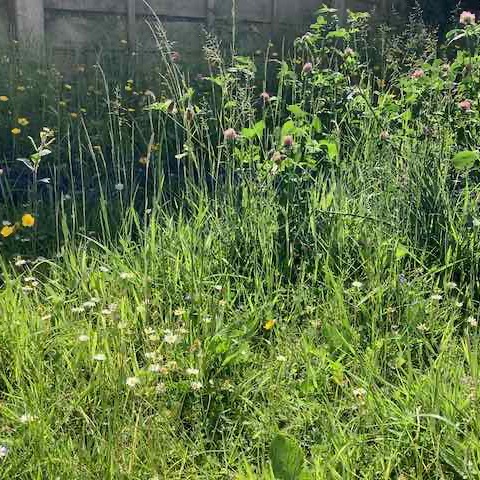
No Mow May has come and gone, and the scribes are hard at work on No Mow June. This will be followed by No Mow July, August and most of September. The scythe will come out as we head into October for the yearly chop and clearance. It has been interesting (to me, anyway) to see the character of the wildflowers slowly change over the past three years as there are now more perennials establishing themselves than annuals. The delight that are the spotted orchids are doing well, and two of them have started to send up flower spikes.



The plants in the greenhouse are doing well. The beefsteak tomatoes have begun to set fruit, and the chillis are coming along. The finger chillis are small and green, but it won’t be much longer before the first are ready to pick. The habaneros are behind and have yet to flower.
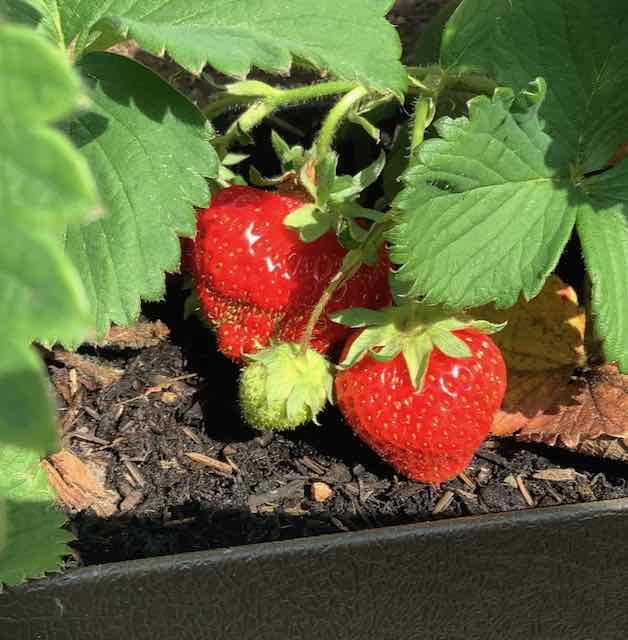
Outside in the kitchen garden, the first strawberries have been picked, as well as chard, lettuce, mixed leaves, radishes and spring onions. The red currants are a little way off yet. The blueberries are even further.
It is only right to report that the kale has been absolutely devastated by white butterfly caterpillars (the butterflies are white: the caterpillars are green) and another sowing has had to be done. While it is pleasing to see a lot more insects this year, it is sad to see the kale reduced to stalks. Netting has been ordered to protect the next lot. Sorry, butterflies.
The experiment to grow sweetcorn, climbing beans and squash together in what is called Three Sisters planting continues. The leaves were looking a bit yellow rather than a lush green, so a dose of plant food was applied. This seems to be doing the trick, so more feeding is planned. The problem was the new topsoil added to the kitchen garden earlier this year, which was a mixture of soil and spent mushroom compost. Research into mushroom compost revealed that it can be quite alkaline as chalk is added to it, which has a negative effect on plants’ ability to take up nutrients (it’s fine for mushrooms, but not much else). The churn with the existing soil as worms and other critters turn it over will take care of the pH balance, but additional nutrients need to be introduced in the short term.

The mystery seed found in a packet of peacock orchids and planted remains a mystery. It has grown another leaf, but so far, a positive identification of what is growing remains elusive. The best guess is still sweet flag, but until it flowers, the jury is still out. The peacock orchids should be flowering next month.
What The Scribes Have Been Reading And Watching
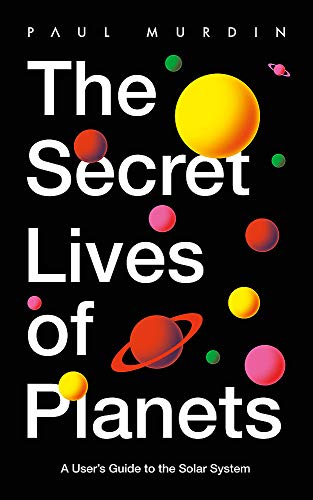
I’m almost at the end The Secret Lives of Planets by Paul Murdin. I’ve found it to be an interesing read if you’re into astronomy. If you’re not, there’s a good chance that it will leave you cold. It’s a well written book, full of facts and details, which is where I think that if you’re not into that kind of thing, this isn’t the book for you. Having worked our way out from the sun, past Earth, the asteroid belt and the giant planets, we’re now lurking beyond the orbit of Neptune, taking a look at Kuiper belt objects. One short chapter and I’ll run into the index and it will be time to stop and move on to the next book in the TBR pile.
TV watching has taken a bit of a back seat now that the weather is getting warmer, and outside is more of an option. Regular viewing was interrupted by the arrival of the Chelsea Flower Show, to the detriment of The 100. When it came to catching up with it again, I found that I couldn’t be bothered with it and began to wonder why.

It wasn’t that I hadn’t been enjoying it, but there was something about it that I couldn’t put my finger on. Then, by chance, I happened upon something called the Idiot Plot. Wikipedia says, “an idiot plot is one which is kept in motion solely by virtue of the fact that everybody involved is an idiot.” I read on.
“It is a narrative where its conflict comes from characters not recognizing, or not being told, key information that would resolve the conflict, often because of plot contrivance.” Ah, I thought. We might be on to something here.
“In most adventure films and novels, the writers and directors have an imperative to keep their protagonists in jeopardy. This becomes difficult if they are surrounded by skilled professionals, paid to intervene and help if called. Hence, storytellers feel compelled to separate their characters from meaningful help, so that any assistance they receive is either late or else below the level of danger offered by the antagonists. The more powerful the villains, the more competent that help is allowed to be.” Bingo! We have a winner! Apologies if you are a fan of the show—you enjoy it. I can see its appeal, but it’s not for me.
Having given up on The 100, I started to look for something new to watch and failed miserably. So, the DVDs of Community were dug out and dusted off. The show ran from 2009 to 2015, so it was old enough to be fresh again. I have to say, it’s a bit like catching up with an old friend. Yes, you know what’s coming up and what’s going to happen, but it isn’t taxing to watch, and while the characters might at times be idiots, it isn’t an idiot plot.

There is a real sense of character development as the series progresses. More on this in the next Newsletter as there were six seasons (and no movie).

Dear Alexa,
Is there a quick way to get rid of, I don’t want to say, well, I say *I* don’t want to, but it’s my friend, who goes to a different priory, and he’s got, wotsits, on his you-know-what (not that, the other end), which makes it difficult to sit down. Is there a cream or ointment that will help?
Unable To Sit Down Properly
Dear Unable To Sit Down Properly,
The word you are looking for is hemmeroids heaemrods hemrhoidis piles, which can be very uncomfortable. Your friend will find a tube of Icy Blast in the medicine cupboard at his priory, but remind him to go to the pharmacy in the town where he lives to replace it as there isn’t much left.
Alexa

Rhubarb and Ginger Crumble
Crumble can be made with many fruit fillings. Apple, blackberry and apple, and gooseberry are probably the best known. The scribes eat a lot of Mrs Pritchett’s rhubarb and ginger crumble because a) it is delicious, b) she likes to make crumble, and c) the kitchen garden produces a lot of rhubarb in spring and early summer that needs using.
Serves 4-6
Prep time: 15 mins
Cook time: 45 minutes
Ready: 1 hour
Ingredients
For the filling:
500g fresh rhubarb, cut into chunks
150g sugar
¾ tsp of arrowroot or cornflour
2 tbsp fresh ginger, finely grated or 25g stem ginger, finely chopped
For the topping:
150g plain flour
100g unsalted butter, chilled
100g brown sugar
50g rolled oats
Directions
1. Preheat the oven to 180ºC/fan 160ºC/gas 4.
2. Mix the rhubarb with the filling sugar, the arrowroot or cornflour, and the ginger. Spread it out evenly in a baking dish.
3. Mix the flour and butter together in a large bowl. Use your fingers to rub the butter into the flour until you get something that resembles coarse breadcrumbs. Then add the topping sugar and the oats and combine.
4. Sprinkle the topping over the rhubarb in the dish. Again, spread it out evenly before popping it into the oven.
5. After about 45 minutes, the top should be golden and the filling should be bubbling around the edges. Give it a few more minutes if it’s not quite there yet. If you give it too long and the top is black, something has gone horribly wrong. Turn off the oven and open the windows.
When it is ready, allow the crumble to cool for a few minutes before serving. Serve with lashings of custard. Ice cream or double cream are good alternatives if you haven’t made custard.
Serve with warmed pitta bread or as a side dish.
Scribes’ Note:
To make the topping crunchier, add 50g of coarsely chopped hazelnuts to the topping mix.
Place a baking tray beneath the dish to prevent any drips from the juices overspilling and making a mess at the bottom of the oven.
Adding the arrowroot or cornflour helps to thicken the juices from the rhubarb.
 Mark Weaver